
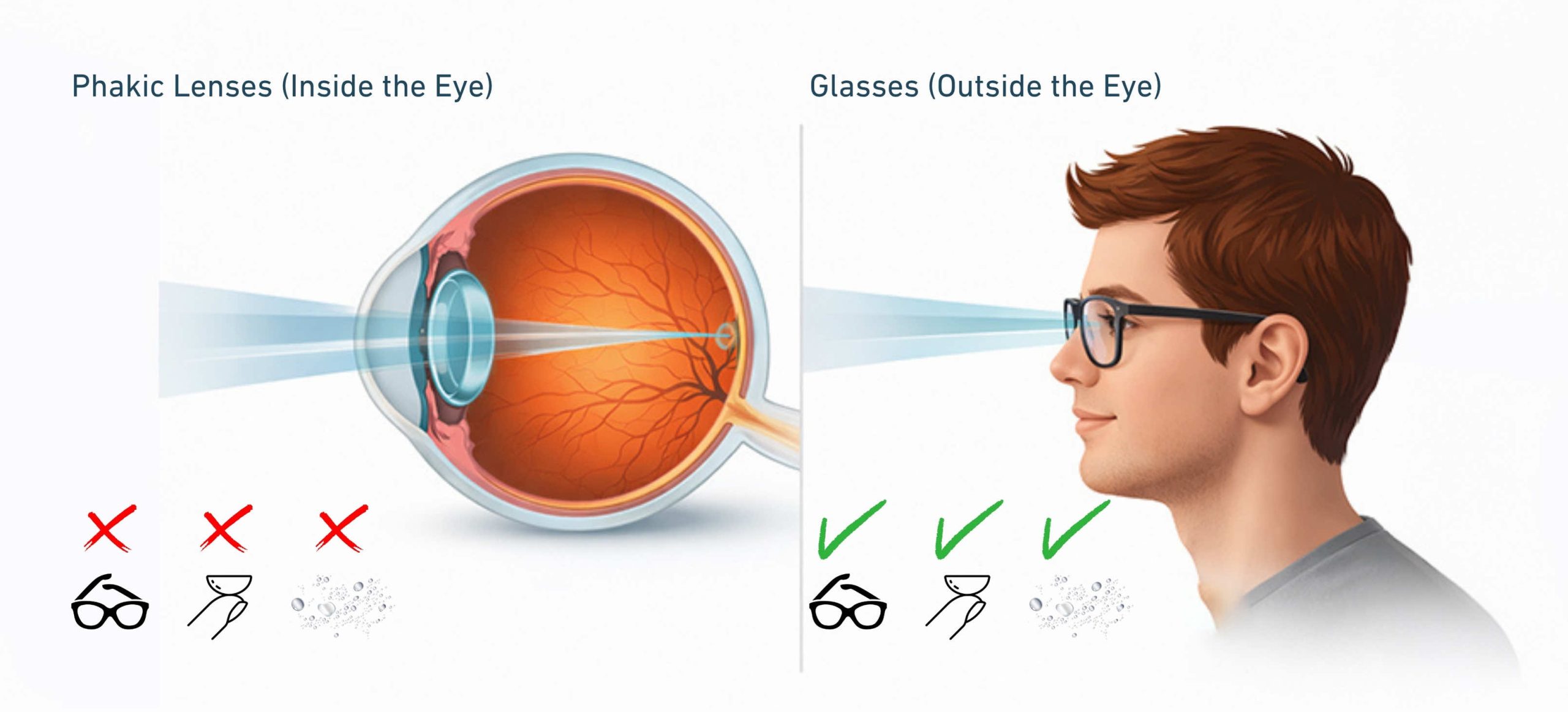
When considering vision correction options, understanding the visual differences between phakic lenses and traditional glasses becomes essential for making an informed decision. Phakic lenses are surgically implanted intraocular devices that work alongside your natural lens to correct refractive errors, particularly nearsightedness, while glasses remain the most common external correction method. The way these two options affect your daily visual experience differs significantly in terms of clarity, field of view, and overall perception.
Many people exploring alternatives to glasses wonder how phakic lenses compare in real-world visual performance. From peripheral vision to night-time clarity, each correction method offers distinct advantages and considerations. Understanding these visual differences helps you evaluate which option aligns better with your lifestyle, visual demands, and personal preferences for achieving optimal vision correction.
Table of Contents
ToggleVisual Clarity: Phakic Lenses vs. Glasses
The fundamental difference in visual clarity between phakic lenses and glasses stems from their positioning relative to your eye. Phakic lenses sit directly inside the eye, either in front of or behind the iris, creating a stable optical system that moves naturally with your eye movements. This internal positioning eliminates many of the optical distortions that external correction methods introduce, providing a more consistent visual experience throughout your entire field of vision.
| Aspect | Phakic Lenses | Glasses |
| Image Size | Natural, life-size images without magnification or minification effects | Slight size distortion depending on prescription strength |
| Optical Distortion | Minimal distortion as lenses move with the eye | Peripheral distortion increases with stronger prescriptions |
| Visual Stability | Consistent clarity regardless of head position or movement | Clarity varies when looking through different lens areas |
| Environmental Factors | Unaffected by weather conditions like rain or fog | Can be impaired by moisture, smudges, or temperature changes |
Glasses create a fixed distance between the corrective lens and your eye, which can introduce optical aberrations, especially in higher prescriptions. The further the corrective surface sits from your eye, the more pronounced these distortions become. Phakic lenses eliminate this distance factor entirely, working as an integrated part of your eye’s optical system to deliver sharper, more natural vision quality across all viewing angles.
Night Vision Performance: Phakic Lenses or Glasses?
Night vision performance represents a critical consideration when comparing phakic lenses to glasses, as low-light conditions reveal distinct differences in how each correction method handles visual challenges. During nighttime or in dimly lit environments, your pupils naturally dilate to allow more light into the eye, which can expose optical limitations in both correction approaches but in different ways.
With glasses, night vision challenges often include glare from oncoming headlights, halos around street lights, and reflections on the lens surface itself. The external lens position creates multiple surfaces where light can reflect or refract unexpectedly, particularly when light sources hit the glasses at certain angles. Anti-reflective coatings help reduce these effects but cannot eliminate them entirely. Additionally, the frame edges can create blind spots in peripheral vision, which becomes more noticeable when driving at night or navigating poorly lit areas.
Phakic lenses offer advantages in night vision by eliminating external reflections and maintaining a stable optical path regardless of lighting conditions. However, some individuals with phakic lenses may experience halos or glare around bright lights, particularly in the initial adaptation period. Modern phakic lens designs minimize these effects through advanced optics and appropriate sizing. The absence of external surfaces means no rain droplets, smudges, or fog can interfere with your vision during nighttime activities, providing more reliable visual performance in challenging conditions.
Your individual pupil size and the specific characteristics of your refractive error influence how each option performs in low-light situations, making personalized evaluation important for night vision considerations.
Differences in Field of View
Field of view differences between phakic lenses and glasses significantly impact your daily visual experience, particularly during activities requiring broad peripheral awareness. The way each correction method affects your visual field determines how naturally you can interact with your environment and perform various tasks.
- Unrestricted Peripheral Vision: Phakic lenses provide complete peripheral vision without any physical barriers or frame obstructions. Your corrected vision extends to the natural limits of your eye’s visual field, allowing full awareness of your surroundings. This proves especially valuable during sports, driving, or any activity requiring spatial awareness.
- Frame Limitations: Glasses inherently restrict your field of view through frame edges, temples, and the limited size of the lens area. Even with larger frames, you experience uncorrected vision beyond the lens boundaries, creating a defined border between corrected and uncorrected zones that can feel restrictive.
- Head Movement Dependency: With glasses, you often need to turn your entire head to see clearly in your peripheral vision, as looking through the edge of the lens introduces distortion. Phakic lenses eliminate this limitation, allowing natural eye movement to access your full visual field with consistent clarity.
- Optical Sweet Spot: Glasses have an optimal viewing zone typically centered in the lens, with quality degrading toward the edges. Phakic lenses maintain consistent optical quality throughout your entire range of vision, as the correction moves naturally with your eye.
This fundamental difference in field of view makes phakic lenses particularly appealing for individuals with active lifestyles or professions requiring excellent peripheral awareness and unrestricted visual access to their environment.
Aesthetics and Comfort Comparison
Beyond pure visual performance, the aesthetic and comfort aspects of phakic lenses versus glasses influence daily quality of life and personal satisfaction with vision correction. These practical considerations often weigh heavily in the decision-making process for individuals seeking freedom from external eyewear.
| Factor | Phakic Lenses | Glasses |
| Physical Presence | Completely invisible; no external indication of vision correction | Visible on face; becomes part of personal appearance |
| Daily Maintenance | No cleaning, adjusting, or removal required during daily activities | Regular cleaning, adjustment, and careful handling necessary |
| Physical Comfort | No pressure points, no weight on nose or ears, no fogging issues | Can cause discomfort from nose pads, ear pressure, or frame weight |
| Activity Limitations | No restrictions for sports, swimming, or physical activities | May require removal or special sports glasses for certain activities |
| Weather Impact | Unaffected by rain, snow, temperature changes, or humidity | Susceptible to fogging, water droplets, and temperature-related issues |
Phakic lenses offer the aesthetic advantage of maintaining your natural appearance without altering your facial features or requiring coordination with clothing and accessories. The comfort factor extends beyond physical sensation to include the psychological freedom of not managing external eyewear throughout your day, particularly during exercise, outdoor activities, or social situations where glasses might feel cumbersome or limiting.
Who is the Best Option for?
Determining whether phakic lenses or glasses represent the better choice depends on multiple individual factors including your refractive error severity, lifestyle demands, age, overall eye health, and personal preferences regarding vision correction approaches. Each option serves different needs and circumstances effectively.
Glasses remain an excellent choice for individuals seeking non-invasive, reversible vision correction without surgical intervention. They work well for people with mild to moderate refractive errors, those who prefer the flexibility of removing their correction when desired, individuals who enjoy glasses as a fashion accessory, or anyone with medical conditions that make surgery inadvisable. Glasses also suit people who experience frequent prescription changes or prefer the lower initial cost and simplicity of external correction methods.
Phakic lenses become particularly attractive for individuals with moderate to high nearsightedness who desire freedom from external eyewear and qualify medically for the procedure. Active individuals, athletes, or professionals whose work involves physical activity or challenging environmental conditions often benefit significantly from the unrestricted vision and durability that phakic lenses provide. People who find contact lenses uncomfortable or unsuitable, those seeking a permanent correction solution, or individuals whose prescriptions fall outside the range effectively treated by laser vision correction may find phakic lenses ideal.
The decision ultimately requires comprehensive eye examination, discussion of your visual goals with an eye care professional, and careful consideration of both the benefits and commitments associated with each correction method to determine which aligns best with your unique circumstances and expectations.
Frequently Asked Questions
Understanding the practical aspects of phakic lenses compared to glasses helps clarify common concerns about vision correction options. These frequently asked questions address the most common considerations people have when evaluating their choices for achieving clearer vision without traditional eyewear limitations.
Can phakic lenses completely replace glasses?
For many individuals, phakic lenses can completely replace glasses for distance vision correction. However, some people may still need reading glasses as they age due to natural presbyopia. The lenses effectively correct nearsightedness, allowing most daily activities without external eyewear.
Is vision quality better with phakic lenses than with glasses?
Vision quality with phakic lenses often surpasses glasses due to reduced optical distortions, natural image size, and unrestricted peripheral vision. The internal positioning eliminates issues like reflections, smudges, and environmental interference that commonly affect glasses, providing more consistent visual clarity.
Which is more advantageous for night vision: phakic lenses or glasses?
Phakic lenses typically offer advantages for night vision by eliminating external reflections and glare from lens surfaces. While some individuals may experience halos initially, the absence of frame obstructions and surface reflections generally provides better low-light visual performance than glasses.
Are phakic lenses permanent or removable?
Phakic lenses are designed as permanent vision correction but remain removable if necessary. Unlike procedures that permanently alter corneal tissue, the lenses can be surgically removed or replaced if your prescription changes significantly or if complications arise, offering reversibility that some refractive surgeries cannot provide.
Do I stop needing glasses completely after wearing phakic lenses?
Most people achieve independence from glasses for distance vision after phakic lens implantation. However, reading glasses may eventually become necessary due to age-related presbyopia. Some individuals might occasionally use glasses for specific tasks requiring enhanced visual precision or comfort in certain situations.
