
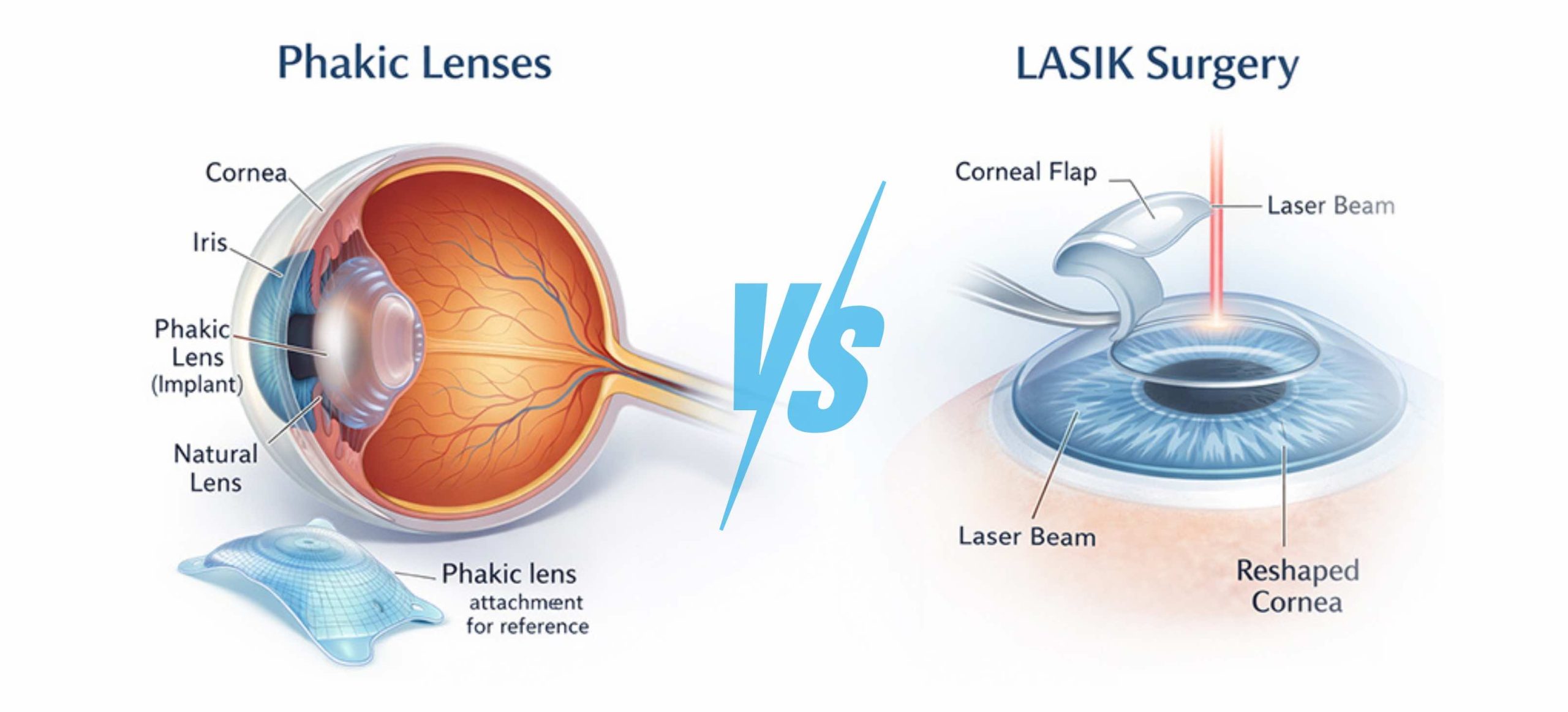
Choosing between vision correction procedures can feel overwhelming, especially when considering options like LASIK and phakic lenses. Both procedures aim to reduce your dependence on glasses or contact lenses, yet they work in fundamentally different ways. A phakic lens is an implantable lens made of plastic or silicone that sits inside your eye without removing your natural lens, making it a unique alternative to laser-based treatments. Understanding which procedure aligns with your eye structure, lifestyle, and long-term vision goals is essential for making an informed decision that supports your visual health for years to come.
Table of Contents
Toggle1. Suitability for Eye Structure: Is LASIK or Phakic Lens More Suitable?
Your eye’s unique anatomy plays a crucial role in determining which vision correction procedure will work best for you. LASIK reshapes the cornea using laser technology, which means it requires sufficient corneal thickness to safely remove tissue. If your cornea is too thin or irregularly shaped, LASIK may not be a viable option, as excessive tissue removal can compromise structural integrity and lead to complications. This is especially relevant for patients with high myopia or high hyperopia, with or without astigmatism, as their eye structure may limit the suitability of cornea-based procedures like LASIK.
Phakic lenses, on the other hand, do not alter the cornea at all. Instead, they are surgically implanted inside the eye, either just in front of or behind the iris, while your natural lens remains intact. This makes phakic intraocular lenses particularly suitable for individuals with thin corneas or those with higher degrees of nearsightedness that exceed the correction range of LASIK.
- Corneal thickness considerations: LASIK requires adequate corneal tissue, while phakic lenses bypass this limitation entirely by working within the eye’s internal structure.
- Degree of refractive error: Phakic lenses can correct more severe cases, including high myopia or high hyperopia, with or without astigmatism, making them ideal for patients whose prescription falls outside the laser correction range.
- Eye health factors: Conditions like dry eye syndrome or corneal irregularities may make LASIK less suitable, whereas phakic lens implantation can often proceed safely in these cases.
- Natural lens preservation: Phakic lenses allow you to keep your eye’s natural focusing ability, which can be beneficial for maintaining accommodation and overall visual quality.
2. Application Process and Surgical Steps: Differences Between LASIK and Phakic Lenses
The surgical approach for each procedure differs significantly, affecting both the experience and recovery process. Understanding these differences helps you prepare mentally and physically for what lies ahead.
- LASIK procedure: During LASIK, your surgeon creates a thin flap in the cornea using a specialized blade or laser. This flap is lifted to expose the underlying corneal tissue, which is then reshaped using an excimer laser to correct refractive errors. The flap is repositioned afterward, where it naturally adheres without stitches. The entire process typically takes a short amount of time per eye, and many patients notice improved vision almost immediately.
- Phakic lens implantation: For phakic lens surgery, a small incision is made in the front of the eye. The surgeon then inserts the phakic intraocular lens through this opening and carefully positions it either in front of or behind the iris, depending on the lens type. The natural lens remains untouched throughout the procedure. Because the incision is minimal, healing occurs relatively quickly, though the recovery timeline differs from LASIK.
- Anesthesia and comfort: Both procedures use local anesthetic eye drops to ensure comfort during surgery. You remain awake throughout, but you should not feel pain. Some patients report mild pressure sensations during LASIK, while phakic lens patients may feel slight movement as the lens is positioned.
- Post-operative care: After LASIK, you will need to avoid rubbing your eyes and use prescribed eye drops to promote healing. Phakic lens patients also receive eye drops and must attend follow-up appointments to monitor lens position and eye pressure, ensuring optimal long-term results.
3. Reversibility: Phakic Lens or LASIK?
One of the most significant distinctions between these two vision correction procedures lies in their reversibility. LASIK permanently alters the shape of your cornea by removing tissue, which cannot be replaced or reversed. Once the corneal tissue is reshaped, the change is permanent. While enhancements or touch-up procedures can be performed if your vision changes over time, the original corneal structure cannot be restored.
In contrast, phakic lenses offer a reversible solution. Because the lens is implanted without removing or altering your natural lens or corneal tissue, it can be removed or replaced if necessary. This flexibility is particularly valuable if your vision changes significantly in the future, if complications arise, or if newer vision correction technologies become available. The ability to reverse the procedure provides peace of mind for many patients who want to preserve their options.
This reversibility also means that if you develop cataracts later in life, the phakic intraocular lens can be removed during cataract surgery, and a standard intraocular lens can be implanted in its place. LASIK patients who develop cataracts will still undergo cataract surgery, but their reshaped cornea remains permanently altered, which can affect lens power calculations and surgical planning.
For individuals who value flexibility and the option to adapt to future eye health changes, phakic lenses present a compelling advantage. However, it is important to discuss your long-term vision goals and health considerations with your eye care professional to determine which approach aligns best with your personal circumstances and expectations.
4. Visual Quality and Long-Term Results: Comparison of LASIK and Phakic Lenses
Both LASIK and phakic lenses can deliver excellent visual outcomes, but the quality and stability of your vision may differ based on the procedure you choose. Understanding these nuances helps you set realistic expectations and choose the option that best supports your lifestyle and visual demands.
| Aspect | LASIK | Phakic Lens |
| Visual clarity | Provides sharp vision for most patients, though some may experience halos or glare, especially at night | Often delivers high-quality vision with minimal optical distortions, as the natural lens remains intact |
| Stability over time | Vision remains stable for many years, though age-related changes like presbyopia will still occur | Long-term stability is generally excellent, with the lens maintaining its position and corrective power |
| Accommodation ability | Does not affect your eye’s natural focusing ability, but presbyopia will develop with age regardless | Preserves natural accommodation longer, as the natural lens continues to function normally |
| Night vision quality | Some patients report increased sensitivity to glare or halos around lights in low-light conditions | Typically fewer reports of night vision disturbances, though individual experiences vary |
Many patients who undergo phakic lens implantation report high satisfaction with their visual quality, particularly because the procedure does not remove corneal tissue or alter the eye’s natural optics beyond adding the corrective lens. This preservation of natural structures can contribute to more predictable visual outcomes and fewer optical side effects.
However, LASIK has a longer track record and extensive research supporting its safety and effectiveness for a wide range of refractive errors. The procedure has been refined over many years, and technological advances continue to improve precision and outcomes. Your individual eye health, prescription, and lifestyle needs will ultimately guide which procedure offers the best long-term visual quality for you.
Regular follow-up care is essential for both procedures to monitor your vision and eye health over time. Whether you choose LASIK or a phakic intraocular lens, maintaining open communication with your eye care provider ensures that any changes or concerns are addressed promptly, supporting your visual health for years to come.
