
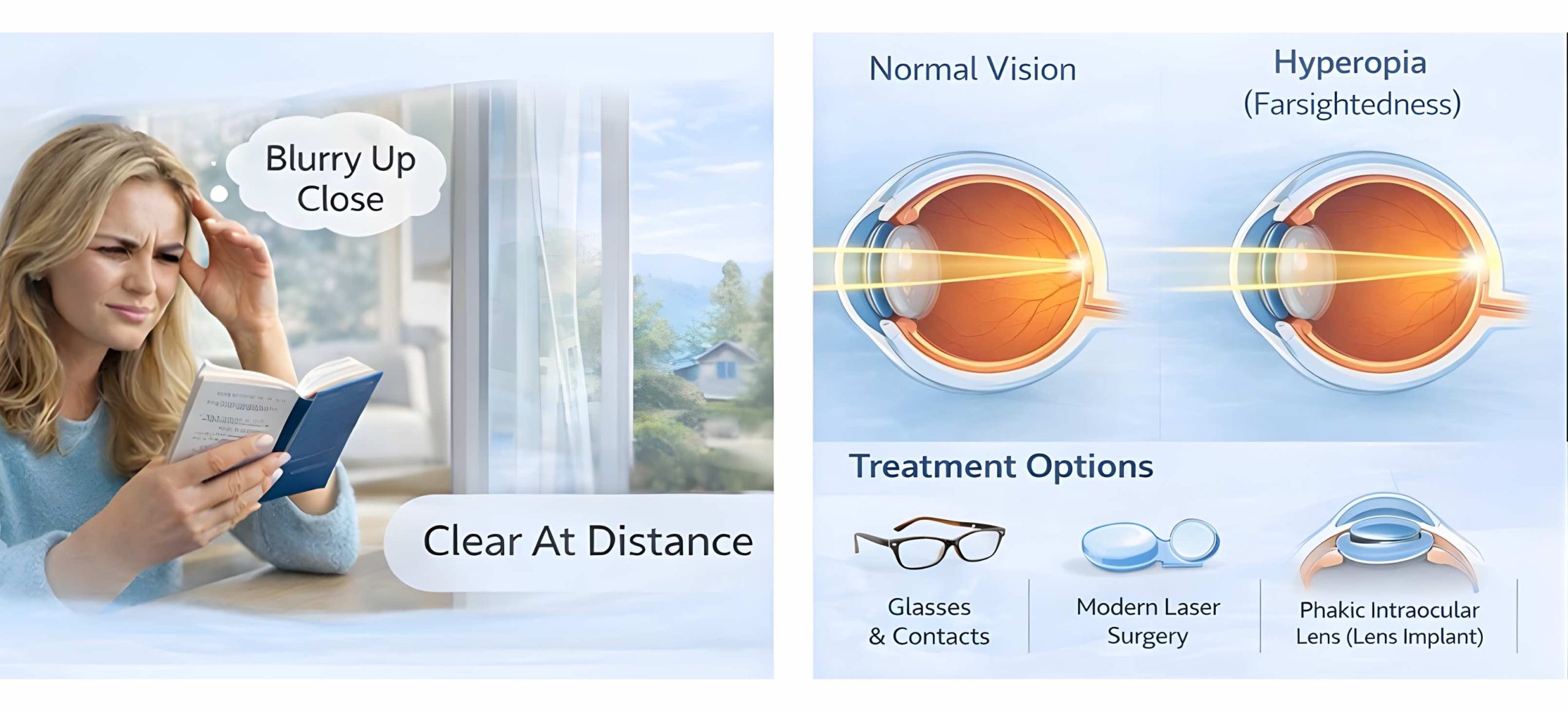
Hyperopia, commonly known as farsightedness, affects millions of people worldwide, causing difficulty in seeing nearby objects clearly while distant vision remains relatively unaffected. This refractive error occurs when light entering the eye focuses behind the retina rather than directly on it, creating blurred near vision. Modern treatment of farsightedness has evolved significantly, offering patients various correction options including traditional methods and advanced surgical procedures. Among these innovative solutions, phakic intraocular lens implantation stands out as a revolutionary approach that preserves corneal integrity while providing exceptional visual outcomes for hyperopic patients.
Table of Contents
ToggleWhat is Hyperopia? Symptoms and Effects on Eye Health
Hyperopia is a refractive error where the eye’s focusing power is insufficient to bring near objects into clear focus on the retina. This condition typically results from an eyeball that is shorter than normal or a cornea that has less curvature than required for proper light refraction. Unlike myopia, where distant objects appear blurry, hyperopia primarily affects near vision.
The most common symptoms of hyperopia include persistent eyestrain, particularly after reading or performing close-up tasks, frequent headaches, and difficulty maintaining focus on nearby objects. Many hyperopic individuals experience burning sensations in their eyes and general discomfort after prolonged near work. Children with hyperopia may exhibit signs of crossed eyes or lazy eye, as their visual system struggles to compensate for the focusing difficulties.
Hyperopia significantly impacts daily activities, from reading and computer work to hobbies requiring detailed vision. The constant effort to focus on near objects can lead to chronic fatigue and reduced productivity. Additionally, untreated hyperopia in children can result in amblyopia or strabismus, potentially causing permanent vision problems if not addressed early. The condition tends to worsen with age as the eye’s natural focusing ability, known as accommodation, gradually decreases.
Long-term effects of uncorrected hyperopia extend beyond visual discomfort. The continuous strain on the ciliary muscles responsible for focusing can lead to premature presbyopia, where the eye loses its ability to change focus between near and distant objects. This acceleration of age-related vision changes makes early intervention crucial for maintaining optimal eye health and preventing complications.
Traditional and Modern Methods Used in Hyperopia Correction
Traditional correction of farsightedness has relied primarily on corrective lenses, including eyeglasses and contact lenses. Prescription glasses with convex lenses help converge light rays to focus properly on the retina, providing immediate visual correction. Contact lenses offer similar benefits while providing a wider field of view and eliminating the cosmetic concerns associated with glasses. These conventional methods remain effective for many patients, particularly those with mild to moderate hyperopia.
Modern refractive surgery has revolutionized hyperopia correction, offering permanent solutions that reduce or eliminate dependence on corrective lenses. LASIK (Laser-Assisted in Situ Keratomileusis) and PRK (Photorefractive Keratectomy) are corneal-based procedures that reshape the cornea to improve its focusing power. These laser surgeries work by steepening the central cornea, allowing light to focus more precisely on the retina.
However, corneal refractive surgeries have limitations, particularly for patients with high degrees of hyperopia or thin corneas. The amount of corneal tissue that can be safely removed is limited, making these procedures unsuitable for severe hyperopic cases. Additionally, corneal procedures permanently alter the eye’s natural structure, which can complicate future treatments or surgeries.
Clear vision surgery options have expanded to include lens-based procedures that preserve corneal integrity. These advanced techniques focus on the eye’s natural lens system rather than modifying corneal shape. Refractive lens exchange and phakic intraocular lens implantation represent the cutting-edge approaches in hyperopia treatment, offering solutions for patients who are not candidates for corneal procedures.
What is a Phakic Lens? How Is It Useful in Hyperopia Correction?
A phakic intraocular lens is an artificial lens implanted inside the eye while preserving the natural crystalline lens. Unlike traditional intraocular lenses used in cataract surgery, phakic lenses work in conjunction with the eye’s natural lens to correct refractive errors. These sophisticated devices are designed to provide permanent vision correction without altering the corneal structure or removing the natural lens.
The application of phakic lenses in hyperopia treatment involves precise surgical placement of the corrective lens either in front of the iris (anterior chamber) or behind the iris but in front of the natural lens (posterior chamber). The most commonly used posterior chamber phakic lenses, such as the (Phakic IOL), are positioned behind the iris where they remain virtually invisible and provide better optical performance.
The surgical procedure for phakic lens implantation is minimally invasive and typically performed on an outpatient basis. After a thorough preoperative evaluation, including detailed eye measurements and corneal mapping, the surgeon creates a small incision in the cornea. The foldable phakic lens is then inserted through this tiny opening and positioned in its designated location within the eye. The entire procedure usually takes less than 30 minutes per eye.
Phakic lenses offer several advantages over corneal refractive surgery for hyperopia correction. They can address higher degrees of refractive error that exceed the safe limits of laser surgery. The procedure is reversible, allowing for lens removal or exchange if needed. Most importantly, phakic lenses preserve the cornea’s natural shape and thickness, maintaining the eye’s structural integrity for potential future treatments.
How Phakic Lenses Protect Corneal Tissue in Hyperopia Patients?
Corneal protection technology represents one of the most significant advantages of phakic intraocular lens implantation over traditional refractive surgeries. Unlike LASIK or PRK procedures that permanently remove corneal tissue, phakic lenses achieve vision correction without any corneal modification. This preservation of corneal integrity is particularly crucial for hyperopia patients who may require higher correction powers that would necessitate extensive corneal reshaping in laser procedures.
The cornea serves multiple critical functions beyond vision correction, including protection against infections and maintenance of proper eye pressure. When corneal tissue is removed during laser surgery, the eye’s biomechanical stability can be compromised, potentially leading to complications such as corneal ectasia or irregular astigmatism. Phakic lenses eliminate these risks by working within the eye’s natural optical system rather than altering its structural components.
For patients with thin corneas or irregular corneal topography, phakic lenses provide a safe alternative to corneal-based procedures. These individuals may not be suitable candidates for laser surgery due to insufficient corneal thickness or shape irregularities that could lead to poor outcomes. The preservation of corneal tissue also maintains options for future treatments, should they become necessary due to age-related changes or other eye conditions.
The long-term benefits of corneal preservation extend beyond immediate safety considerations. Maintaining natural corneal structure ensures that the eye’s wound healing response remains intact, reducing the risk of complications such as dry eye syndrome or corneal haze that can occur after laser surgery. Additionally, preserved corneal sensitivity helps maintain the natural blink reflex and tear production, contributing to overall eye health and comfort.
Success Rate and Long-term Results of Phakic Lens Surgery
Phakic intraocular lens implantation is considered an effective and reliable option for the correction of hyperopia. Patients often experience rapid visual improvement after surgery, and these gains are generally maintained over the long term. Reduced dependence on glasses and contact lenses contributes to high levels of patient satisfaction and an improved quality of life.
Modern phakic lenses have demonstrated a strong safety profile, with serious complications being uncommon and most potential issues manageable through regular postoperative follow-up. The procedure typically achieves the intended visual outcome in a single surgery, minimizing the need for additional interventions.
Another key advantage of phakic lens surgery is its predictability. Advances in ocular measurements and lens selection allow surgeons to reach accurate refractive targets with confidence. Along with the reversible nature of the procedure, this predictability makes phakic lenses an appealing option for both patients and surgeons in the treatment of hyperopia.
Frequently Asked Questions
Yes, phakic lens surgery provides a permanent solution for farsightedness. The implanted lens remains in place indefinitely, providing stable vision correction. However, the procedure is reversible if needed, and the lens can be removed or exchanged if circumstances change.
The choice between laser surgery and phakic lenses depends on individual factors such as the degree of hyperopia, corneal thickness, and patient preferences. Phakic lenses are generally better for high degrees of farsightedness, thin corneas, or patients who want to preserve their natural corneal structure.
Phakic lens surgery is typically painless due to topical anesthesia used during the procedure. Most patients experience only mild discomfort for a few hours after surgery, which can be managed with over-the-counter pain medications.
Phakic lenses can correct various refractive errors including myopia (nearsightedness), astigmatism, and combinations of these conditions. They are particularly effective for high degrees of refractive error that exceed the safe limits of laser surgery.
