
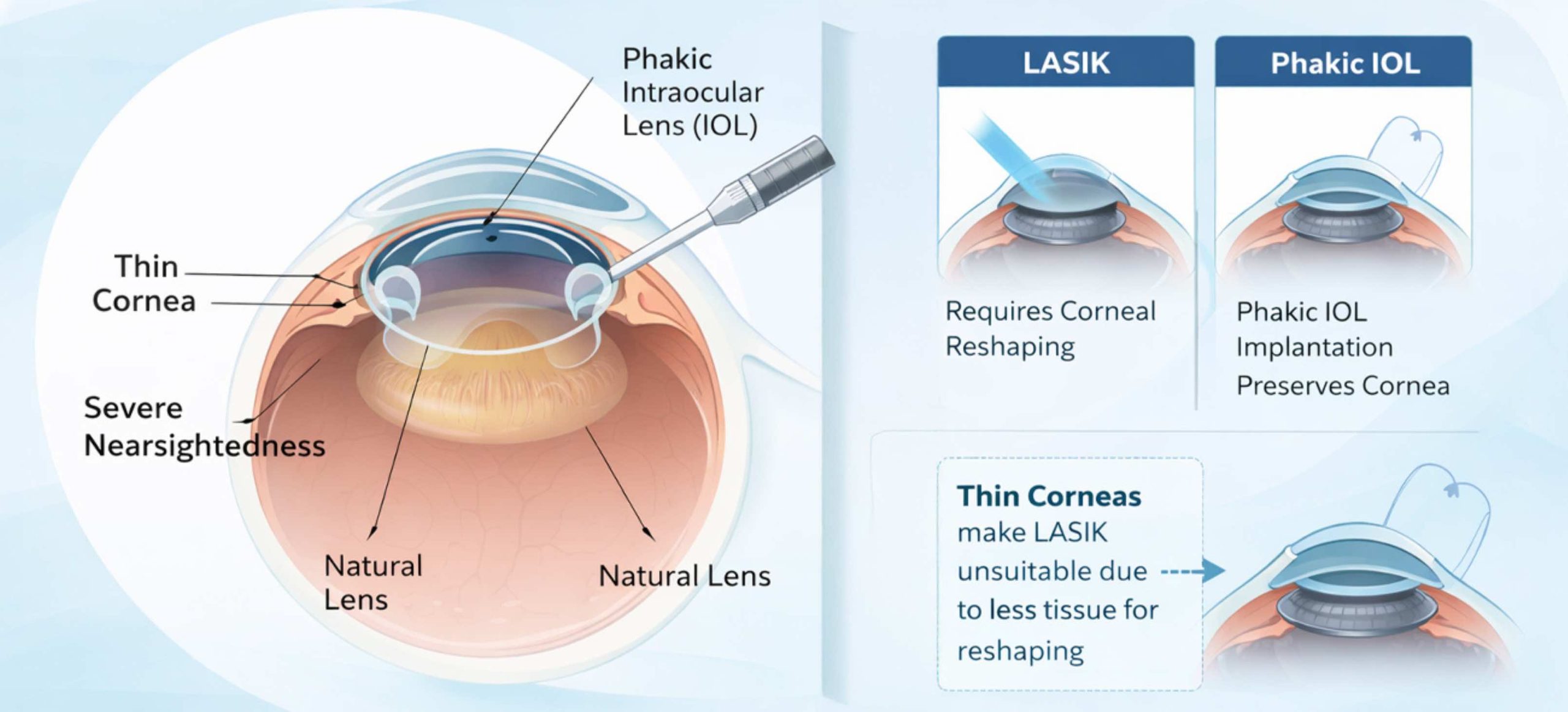
Phakic lens implantation represents a revolutionary solution for individuals with thin corneas and high myopia who cannot undergo traditional laser eye surgery. This advanced intraocular lens surgery offers an effective alternative to laser surgery, providing better vision correction while preserving the eye’s natural lens. For patients with severe nearsightedness and insufficient corneal thickness, phakic lens implantation has become the treatment of high myopia of choice, offering remarkable visual outcomes with minimal complications.
The procedure involves placing a specialized lens inside the eye, working in conjunction with the natural crystalline lens to correct refractive errors. Unlike traditional cataract surgery where the natural lens is removed, phakic lens implantation maintains the eye’s natural focusing ability while providing precise vision correction. This thin corneal solution has transformed the landscape of refractive surgery, offering hope to millions of patients previously considered unsuitable for laser procedures.
Table of Contents
ToggleWhat are Thin Corneas? Do They Prevent Laser Surgery?
Thin corneas refer to corneal tissue that measures less than 500 micrometers in thickness, significantly below the average corneal thickness of 540-560 micrometers. This anatomical variation affects approximately 15-20% of the population and creates substantial limitations for traditional laser eye surgery procedures like LASIK and PRK.
The cornea serves as the eye’s primary refractive surface, contributing approximately 65-75% of the eye’s total focusing power. During laser surgery, precise amounts of corneal tissue are removed to reshape the eye’s focusing ability. However, patients with thin corneas lack sufficient tissue for safe laser ablation, particularly when correcting high degrees of myopia. The risk of complications increases dramatically when corneal thickness falls below critical safety thresholds.
Laser surgery requires maintaining adequate residual bed thickness to preserve corneal structural integrity. When insufficient tissue remains after laser treatment, patients may experience corneal ectasia, a serious complication where the cornea progressively weakens and bulges forward. This condition can lead to irregular astigmatism, visual distortion, and potentially require corneal transplantation in severe cases.
Modern diagnostic technology, including corneal topography and pachymetry, allows surgeons to precisely measure corneal thickness and identify patients unsuitable for laser procedures. These measurements are crucial in determining candidacy for different refractive surgery options and ensuring patient safety.
What is High Myopia and What Risks Does It Carry?
High myopia, defined as refractive error exceeding -6.00 diopters, affects millions of people worldwide and presents unique challenges for vision correction. This severe form of nearsightedness occurs when the eyeball grows excessively long or the cornea becomes too steep, causing light to focus in front of the retina rather than directly on it.
Patients with high myopia are at significantly higher risk of serious eye complications throughout their lives. The elongated eyeball structure that accompanies severe myopia leads to stretching and thinning of the retinal tissue, making it more susceptible to problems such as tears and detachment. Although retinal detachment is a rare condition in the general population, the risk is significantly increased in individuals with high myopia.
High myopia is associated with a higher risk of developing glaucoma compared to individuals with normal eye structure. In highly myopic eyes, the tilted or enlarged appearance of the optic nerve head can make clinical evaluation and early diagnosis of glaucoma more difficult. In addition, cataracts that appear at a young age are more frequently observed in patients with severe myopia and generally develop earlier compared to normal eyes.
The psychological and social impact of high myopia cannot be understated. Patients often experience significant dependence on thick, heavy glasses or contact lenses, affecting their quality of life, career choices, and participation in sports or recreational activities. Many patients report feeling self-conscious about their appearance and limited by their visual dependence on corrective devices.
What is Phakic Lens Implantation?
Phakic lens implantation is a sophisticated surgical procedure that involves placing an artificial intraocular lens inside the eye while preserving the natural crystalline lens. This innovative technique provides better vision correction for patients with high myopia, hyperopia, and astigmatism who are not suitable candidates for laser surgery.
The procedure utilizes specially designed lenses that work in harmony with the eye’s natural focusing system. Unlike cataract surgery where the natural lens is removed and replaced, phakic lenses are positioned either in front of the iris (anterior chamber) or behind the iris but in front of the natural lens (posterior chamber). The most commonly used posterior chamber phakic lens is the Eyecryl Phakic IOLs, which has demonstrated exceptional safety and efficacy profiles.
Types of Phakic Lenses
Modern phakic lens technology offers several design options to accommodate different eye anatomies and refractive errors. Anterior chamber phakic lenses are positioned in the space between the cornea and iris, secured either by angle fixation or iris fixation mechanisms. These lenses are suitable for patients with adequate anterior chamber depth and normal corneal endothelial cell counts.
Posterior chamber phakic lenses, particularly the phakic intraocular lens (Phakic IOL), represent one of the most advanced options currently available. These lenses are manufactured from a highly biocompatible material engineered to provide excellent optical performance and long-term compatibility with ocular tissues. The Phakic IOL design features a central optical zone for vision correction and haptics that gently vault over the natural lens, maintaining appropriate clearance to help reduce the risk of cataract formation.
Surgical Procedure Details
The phakic lens implantation procedure is performed on an outpatient basis under topical anesthesia, typically requiring 10-15 minutes per eye. Prior to surgery, patients undergo comprehensive preoperative evaluation including detailed measurements of eye dimensions, corneal thickness, anterior chamber depth, and endothelial cell count.
During the procedure, a small incision measuring 2.2-2.8 mm is created in the cornea. The phakic lens is folded and inserted through this micro-incision using specialized injection systems. Once inside the eye, the lens unfolds naturally and is positioned appropriately. The small incision typically seals without requiring sutures, promoting rapid healing and visual recovery.
Advantages of Phakic Lens Implantation for High Myopia
Phakic lens implantation offers numerous advantages over alternative vision correction methods, particularly for patients with high myopia and thin corneas. The procedure provides exceptional visual quality with minimal optical aberrations, often achieving better visual outcomes than thick glasses or contact lenses.
The reversibility of phakic lens implantation represents a significant advantage over laser surgery. While intended as a permanent solution, phakic lenses can be surgically removed if necessary, potentially allowing the eye to return to its pre-surgical refractive state. This reversibility provides peace of mind for patients concerned about long-term complications or future technological advances.
Visual Quality Benefits
Patients with phakic lens implantation typically experience superior visual quality compared to glasses or contact lenses. The lens position inside the eye eliminates peripheral distortion and minification effects common with thick myopic glasses. Additionally, phakic lenses provide a wider field of view and improved peripheral vision compared to glasses.
The biocompatible materials used in modern phakic lenses provide superior optical clarity with minimal light scattering. Patients frequently report improved night vision and reduced glare compared to their previous vision correction methods. In addition, the UV protection incorporated into many phakic lenses offers added benefits for long-term eye health.
Lifestyle Improvements
Phakic lens implantation dramatically improves patients’ quality of life by eliminating dependence on glasses or contact lenses for distance vision. Patients can participate freely in sports, swimming, and outdoor activities without worrying about losing or damaging their corrective devices. The psychological benefits of improved appearance and increased confidence are frequently reported by patients.
The procedure is particularly beneficial for individuals in demanding professions such as pilots, athletes, or military personnel where optimal uncorrected vision is essential. Many patients report improved career opportunities and increased participation in recreational activities following phakic lens implantation.
Candidate Selection and Safety Considerations
Proper candidate selection is crucial for achieving optimal outcomes with phakic lens implantation. Ideal candidates are typically between 21-45 years old with stable refractive error for at least one year. Patients should have adequate anterior chamber depth, healthy corneal endothelium, and realistic expectations about surgical outcomes.
Comprehensive preoperative evaluation includes detailed ocular examination, corneal topography, anterior segment imaging, and endothelial cell count assessment. Patients with certain eye conditions such as glaucoma, uveitis, or retinal problems may not be suitable candidates for the procedure.
Modern phakic lens implantation is a widely performed and generally considered safe surgical procedure. While serious complications are rare, potential risks include infection, inflammation, increased intraocular pressure, and cataract development. Advances in surgical techniques and lens designs have improved the safety of the procedure and reduced the likelihood of adverse effects.
Maintaining the position of the lens, monitoring intraocular pressure, and assessing overall eye health through regular check-ups throughout life are crucial for the continuity of treatment.
Frequently Asked Questions
Yes, patients with thin corneas are ideal candidates for phakic lens implantation. Unlike laser surgery, phakic lens implantation does not require corneal tissue removal, making it ideal for patients with insufficient corneal thickness for LASIK or PRK procedures.
Phakic lenses are very safe for high myopia correction, with better long-term safety profiles demonstrated in clinical studies. The procedure has been FDA-approved since 2005, with continuous improvements in lens design and surgical techniques enhancing safety outcomes.
While phakic lenses are designed to be permanent, they can be surgically removed if necessary. This reversibility distinguishes phakic lens implantation from laser surgery, providing patients with future treatment flexibility.
Most patients experience rapid visual recovery, with significant improvement within 24-48 hours. Complete healing typically occurs within 1-2 weeks, though individual recovery times may vary based on patient factors and adherence to post-operative care instructions.
