
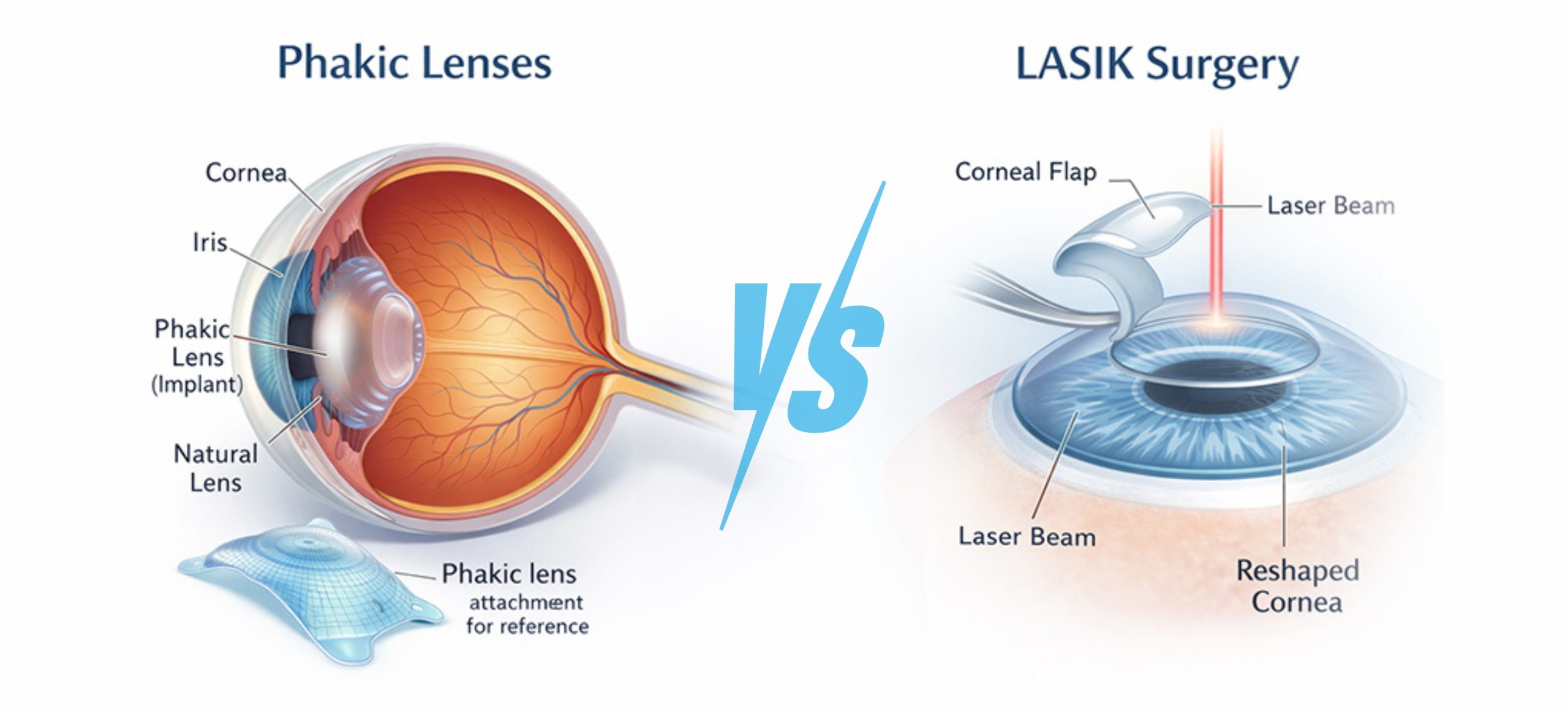
When considering vision correction surgery, understanding how different procedures affect your eye’s natural structure becomes essential for making informed decisions about your long-term eye health. Phakic lenses represent an advanced approach to correcting refractive errors while preserving the cornea’s integrity, offering a distinct advantage over traditional laser-based methods. Unlike procedures that permanently reshape corneal tissue, phakic intraocular lenses work by adding a corrective element inside the eye without altering your cornea’s natural architecture. This preservation-focused approach addresses concerns about corneal integrity, tear production, and the potential complications associated with tissue removal. For individuals seeking vision correction methods that prioritize reversibility and minimal disruption to natural eye structures, understanding the differences between phakic lenses and LASIK surgery provides valuable insight into which refractive surgery option aligns best with your specific needs and long-term vision goals.
Table of Contents
ToggleWhat is the Role of the Cornea in Vision Correction Surgery?
The cornea serves as the eye’s primary refractive surface, responsible for bending incoming light rays so they focus precisely on the retina to create clear images. This transparent, dome-shaped front layer of the eye contributes significantly to your overall focusing power, working in coordination with the natural lens positioned behind it. In traditional refractive surgery approaches, surgeons modify the cornea’s curvature to correct focusing errors, fundamentally changing how light enters and travels through the eye. The cornea’s structural integrity directly influences not only visual clarity but also the eye’s ability to maintain proper tear film distribution, protect against infection, and preserve long-term stability.
During laser-based vision correction procedures, tissue removal from the cornea permanently alters its thickness and biomechanical properties. This reshaping process involves creating a flap or ablating surface tissue to adjust the cornea’s refractive power, addressing nearsightedness, farsightedness, or astigmatism. While effective for many patients, these modifications cannot be reversed, and the cornea’s reduced thickness may affect its structural resilience over time. The procedure also disrupts corneal nerves that play a crucial role in triggering tear production and maintaining the eye’s natural moisture balance.
Corneal integrity encompasses more than just thickness measurements; it includes the complex network of nerve fibers, the regular arrangement of collagen layers, and the delicate balance of hydration that keeps the cornea transparent. When surgical interventions compromise any of these elements, patients may experience changes in visual quality, increased sensitivity to environmental factors, or challenges with tear production that require ongoing management with artificial tears or other supportive treatments. Understanding these fundamental aspects of corneal function helps clarify why preservation-focused approaches like phakic intraocular lenses offer distinct advantages for certain candidates seeking vision correction methods that minimize permanent structural changes to this vital ocular tissue.
LASIK Surgery: Advantages and Risks
LASIK has established itself as a widely performed refractive surgery option, offering rapid visual recovery and proven effectiveness for correcting common focusing errors. The procedure’s popularity stems from its ability to reduce or eliminate dependence on glasses and contact lenses for many patients, with most individuals experiencing improved vision within hours or days following treatment. The surgical technique involves creating a thin corneal flap, reshaping the underlying tissue with a laser, and repositioning the flap to heal naturally without sutures. This approach has benefited millions of patients worldwide, demonstrating consistent outcomes when performed on appropriate candidates.
However, understanding both the benefits and potential drawbacks of LASIK provides a complete picture for those considering this vision correction method. The procedure’s permanent nature means that once corneal tissue is removed, it cannot regenerate, making careful candidate selection and realistic expectation-setting essential components of the decision-making process.
- Rapid visual improvement: Most patients notice significantly clearer vision within the first day after surgery, with continued stabilization occurring over the following weeks. This quick recovery timeline allows individuals to return to normal activities relatively soon, making LASIK an attractive option for those seeking minimal disruption to their daily routines.
- Reduced dependence on corrective eyewear: Successful LASIK outcomes typically eliminate or substantially decrease the need for glasses or contact lenses during everyday activities. This freedom from corrective eyewear represents a significant lifestyle benefit for many patients, particularly those engaged in sports, outdoor activities, or professions where glasses prove inconvenient.
- Established safety profile: Decades of clinical experience and technological refinements have made LASIK a well-understood procedure with predictable outcomes for properly screened candidates. The vast majority of patients achieve their target vision correction without serious complications when treated by experienced surgeons using modern equipment.
- Permanent corneal alteration: The tissue removal inherent to LASIK cannot be reversed, meaning any complications or changes in vision needs over time must be addressed within the context of an already modified corneal structure. This irreversibility requires careful consideration, especially for younger patients whose vision may continue evolving.
- Dry eye concerns: Disruption of corneal nerves during flap creation frequently leads to decreased tear production and chronic dry eye symptoms that may persist for months or, in some cases, become a long-term condition requiring ongoing management with artificial tears or other interventions.
- Structural weakening: Removing corneal tissue reduces the eye’s biomechanical strength, potentially increasing susceptibility to injury or complications in future eye surgeries. Patients with thinner corneas or higher degrees of refractive error face greater tissue removal, amplifying these structural concerns.
Phakic Intraocular Lenses: Vision Correction Without Touching the Cornea
Phakic lenses represent a fundamentally different approach to correcting refractive errors, one that preserves the cornea entirely by placing a corrective lens inside the eye rather than reshaping external structures. These specialized intraocular lenses are surgically implanted through a small incision, positioned either in front of or behind the iris while leaving the eye’s natural lens in place. The term “phakic” specifically refers to this preservation of the natural crystalline lens, distinguishing these implants from lenses used in cataract surgery where the natural lens is removed and replaced.
The surgical procedure for phakic intraocular lens implantation involves creating a tiny opening in the cornea, just large enough to insert the folded lens, which is then carefully positioned in the appropriate location within the eye’s anterior chamber or behind the iris. Once in place, the lens works in conjunction with the cornea and natural lens to redirect light properly onto the retina, correcting nearsightedness without permanently altering any of the eye’s existing refractive surfaces. This approach maintains the cornea’s original thickness, curvature, and nerve network, preserving its natural biomechanical properties and sensory functions.
Because phakic lenses do not involve tissue removal or permanent reshaping, they offer a level of reversibility that laser-based procedures cannot match. If vision needs change over time, if complications arise, or if new treatment options become available, the implanted lens can be removed or replaced, returning the eye to its pre-surgical state. This flexibility proves particularly valuable for younger patients whose vision may continue evolving, or for individuals with higher degrees of refractive error that would require extensive corneal tissue removal with laser procedures. The preservation of corneal integrity also means that patients retain their natural tear film stability and nerve function, significantly reducing the risk of chronic dry eye symptoms that commonly affect LASIK patients.
Phakic intraocular lenses have been approved for correcting moderate to severe nearsightedness, offering an effective solution for individuals who may not qualify as ideal LASIK candidates due to thin corneas, high refractive errors, or concerns about long-term corneal health. The procedure represents a sophisticated vision correction method that prioritizes preservation of natural eye structures while delivering reliable refractive outcomes, making it an increasingly popular choice among both patients and eye care professionals seeking alternatives to traditional refractive surgery approaches.
The Contribution of Phakic Lenses to Long-Term Eye Health
Preserving the cornea’s natural structure through phakic lens implantation offers significant advantages for maintaining long-term eye health, particularly regarding tear film stability and structural resilience. Unlike laser procedures that disrupt the corneal nerve network responsible for triggering reflexive tear production, phakic implants leave these neural pathways intact. This preservation means patients typically maintain their natural tear production capacity, avoiding the chronic dry eye symptoms that affect a substantial portion of LASIK patients. The ability to produce adequate tears naturally supports ocular surface health, reduces infection risk, and maintains visual clarity without requiring ongoing dependence on artificial tears or other supplemental treatments.
The biomechanical stability provided by an unaltered cornea also contributes to long-term structural integrity. When corneal tissue remains at its natural thickness with its collagen architecture undisturbed, the eye retains its original resistance to physical stress and environmental pressures. This structural preservation becomes particularly relevant for individuals engaged in contact sports, those working in physically demanding professions, or anyone concerned about maintaining optimal eye strength throughout their lifetime. Additionally, preserving corneal thickness and structure keeps future treatment options open, allowing patients to undergo other eye procedures if needed without the complications that can arise from working with previously thinned or reshaped corneal tissue.
The reversibility inherent to phakic intraocular lenses represents another crucial factor in long-term eye health planning. As vision needs evolve with age or if complications arise, the implanted lens can be removed or exchanged, providing flexibility that permanent corneal reshaping cannot offer. This adaptability proves especially valuable as patients age and may eventually develop cataracts requiring lens replacement surgery. With phakic implants, surgeons can simply remove the artificial lens and proceed with standard cataract surgery, whereas patients with previous LASIK must navigate the additional complexity of calculating proper lens power for eyes with altered corneal curvature.
Furthermore, maintaining natural corneal integrity preserves the accuracy of diagnostic measurements used to monitor eye health over time. Unchanged corneal topography allows for more reliable glaucoma screening, more accurate intraocular pressure readings, and clearer assessment of retinal health without the confounding factors introduced by surgical corneal modification. This diagnostic clarity supports proactive eye care management throughout a patient’s lifetime, enabling early detection and treatment of age-related conditions that might otherwise go unnoticed or be more difficult to assess in eyes with surgically altered corneas. For individuals prioritizing comprehensive long-term eye health alongside vision correction, phakic lenses offer a preservation-focused approach that aligns with these broader wellness goals.
Which Method is More Suitable for Whom?
Selecting between phakic lenses and LASIK requires careful evaluation of individual eye characteristics, lifestyle factors, and long-term vision goals. Different patient profiles benefit from different approaches, and understanding these distinctions helps ensure optimal outcomes aligned with personal priorities.
- Patients with thin corneas or high refractive errors: Individuals whose corneas lack sufficient thickness to safely undergo laser ablation, or those with severe nearsightedness requiring extensive tissue removal, often find phakic intraocular lenses provide effective correction without compromising corneal structure. The ability to correct higher degrees of refractive error while preserving natural corneal thickness makes phakic implants particularly suitable for patients who would otherwise face increased complication risks with laser procedures.
- Younger patients with evolving vision: Those in their twenties or early thirties whose vision prescription may still be changing benefit from the reversibility that phakic implants offer. Since the natural lens and cornea remain unaltered, future adjustments or alternative treatments remain viable options as vision needs evolve over time, providing flexibility that permanent corneal reshaping cannot match.
- Individuals prioritizing corneal preservation: Patients concerned about maintaining natural tear production, preserving biomechanical strength, or keeping future treatment options open often prefer phakic lenses as their primary vision correction method. This approach particularly appeals to those engaged in contact sports, military personnel, or individuals working in environments where eye protection and structural resilience prove essential.
- Candidates seeking rapid recovery with stable prescriptions: LASIK remains an excellent choice for patients with moderate refractive errors, adequate corneal thickness, stable vision prescriptions, and realistic expectations about potential dry eye management. Those who prioritize quick visual recovery and minimal ongoing intervention often find laser-based refractive surgery meets their needs effectively when proper candidate screening confirms suitability.
- Patients with existing dry eye concerns: Individuals already experiencing tear film instability or dry eye symptoms typically achieve better outcomes with phakic intraocular lenses, which preserve the corneal nerve network essential for maintaining natural moisture balance. Avoiding further disruption to tear production mechanisms helps prevent exacerbation of existing symptoms and reduces long-term dependence on artificial tears or other supplemental treatments.
Ultimately, the most suitable vision correction method depends on comprehensive evaluation by an experienced eye care professional who can assess corneal topography, refractive error magnitude, tear film quality, lifestyle requirements, and individual health priorities. Both phakic lenses and LASIK offer proven effectiveness within their appropriate patient populations, and thorough consultation ensures alignment between surgical approach and personal vision goals while prioritizing long-term eye health outcomes.
Frequently Asked Questions
Understanding common questions about phakic lenses and their comparison to LASIK helps clarify key considerations for those exploring vision correction methods that prioritize corneal preservation and long-term eye health.
Phakic lenses are specialized intraocular lenses implanted inside the eye to correct refractive errors without removing the natural lens. They work by adding an additional focusing element that redirects light properly onto the retina, correcting nearsightedness while preserving all natural eye structures including the cornea and crystalline lens.
LASIK involves creating a corneal flap and reshaping underlying tissue, which disrupts corneal nerves responsible for triggering reflexive tear production. This nerve damage reduces the eye’s natural ability to produce adequate tears, leading to chronic dryness that may require ongoing management with artificial tears or other treatments.
Phakic intraocular lenses preserve corneal integrity by avoiding tissue removal or permanent reshaping. The small incision required for lens insertion heals quickly without affecting corneal thickness, curvature, or nerve function, maintaining the cornea’s natural structure and biomechanical properties throughout the patient’s lifetime.
Ideal candidates include individuals with moderate to severe nearsightedness, thin corneas unsuitable for laser procedures, younger patients with evolving vision, or anyone prioritizing corneal preservation and reversibility. Comprehensive eye examination determines specific suitability based on individual anatomical characteristics and refractive error magnitude.
Phakic lenses are designed for permanent implantation but can be removed or replaced if vision needs change, complications arise, or alternative treatments become necessary. This reversibility distinguishes them from laser procedures, offering flexibility for future vision correction adjustments or cataract surgery as patients age.
For appropriate candidates, phakic lenses offer long-term advantages by preserving natural corneal integrity, maintaining tear production capacity, and keeping future treatment options available. The optimal choice depends on individual eye characteristics, with comprehensive professional evaluation ensuring alignment between surgical approach and long-term eye health priorities.
